Rigid Flex PCB Process
Rigid Flex PCBs combine the benefits of rigid boards with the elasticity of flex circuitry. This design allows for mounting components on both sides of the board, resulting in increased component density and better functionality in space-constrained applications. This design is most common in aerospace and defense, where the rigid flex PCBs can be used to mount electronics on avionics systems, missiles, satellites, or unmanned aerial vehicles (UAVs). Rigid flex PCBs are also often used for high-speed applications, as they offer the ability to route signals between rigid and flex sections without signal degradation. In these types of applications, it is important to consider the minimum bend radius of the flex circuits as well as proper impedance matching between the rigid and flexible sections.
The fabrication process for a rigid-flex pcb starts with the preparation of the base material. This is done by removing the protective coating from the copper coils. This is done by immersing the coils in an acid bath or spraying them with sodium persulphate. The copper coils are then chemically etched to remove the oxidation.
Next, the flex circuit is plated with copper using a standard PCB plating process. Depending on the size of the board, this may be done in one or more stages. The plated copper is then annealed to improve its mechanical properties and electrical performance. A protective coverlay is then applied to the copper layer, which is either an additional polyimide film with adhesive or, for an adhesive-less process, a photo-imageable solder mask. This is then cured to the flex circuit using UV exposure.
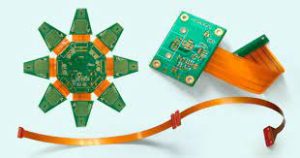
The Rigid Flex PCB Process
In some cases, the flex circuit can have holes and vias plated directly onto it, but this is not always the case for a rigid-flex PCB. When the holes are plated directly on the flex, it is important to avoid placing special copper features in the area that will be subjected to repeated bending. For this reason, it is recommended that all holes be placed a minimum of 0.050” from the transition zone.
Finally, the rigid-flex circuit is affixed to its rigid counterpart using a pressure-sensitive adhesive. The final product is then inspected to ensure that all layers are aligned and free of discontinuities, shorts, or other defects.
Choosing the right manufacturing company to create your rigid-flex PCB is essential. A reliable, experienced manufacturer will be able to provide you with the quality of rigid-flex PCB that you need for your project. They will also be able to handle the complex and demanding production process of this type of circuit board.
Rigid flex circuits are extremely complicated and require meticulous design and assembly. It is important to choose a manufacturer with experience in working with these types of circuit boards, as they will be able to address all the issues that could arise during the production process. This will result in a superior finished product that is durable, efficient, and reliable. To make sure that you choose the right manufacturer, it is a good idea to ask about their capabilities and pricing.